

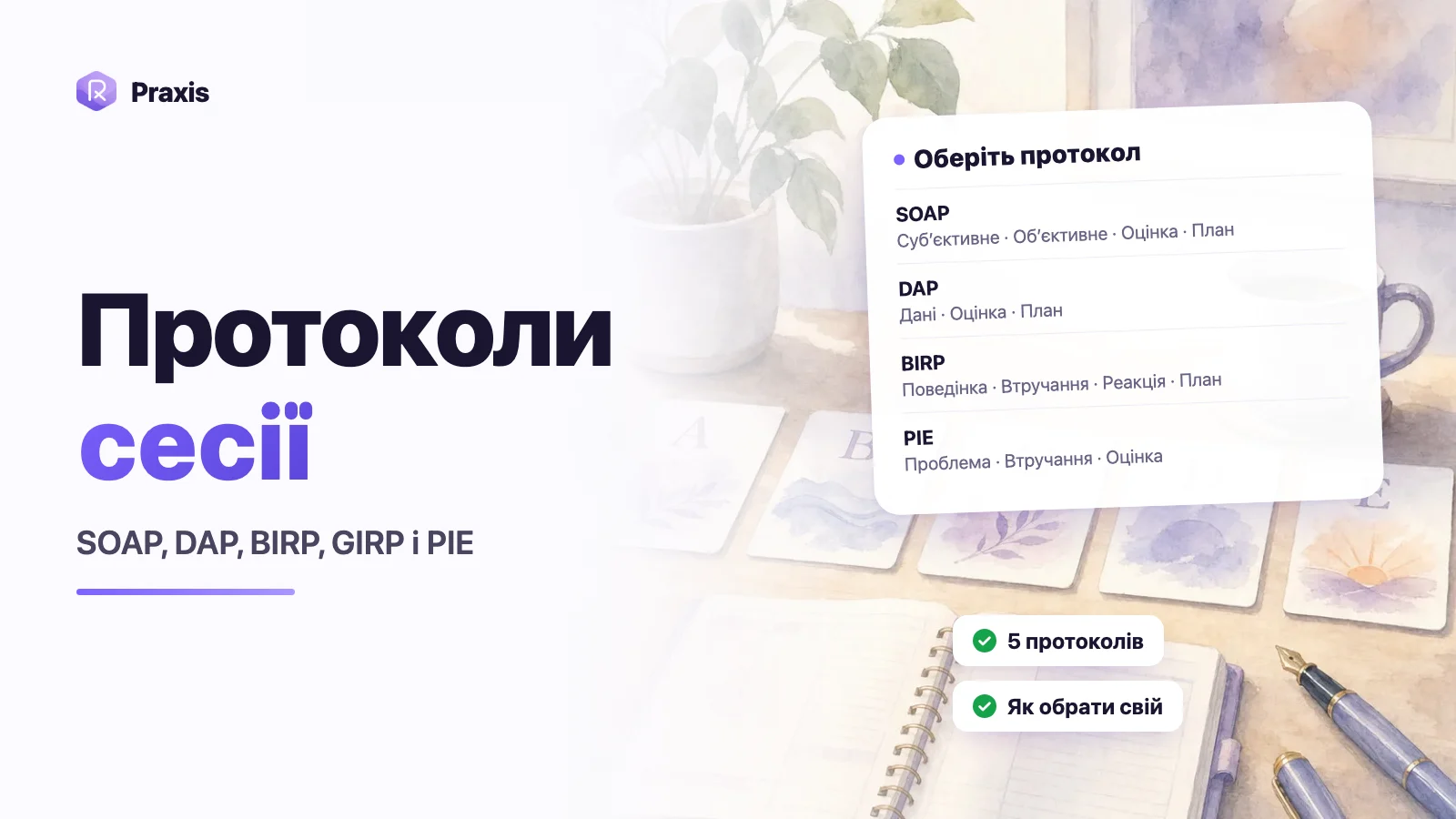
A session note is a record of a meeting organized into fixed sections. The most common formats are SOAP (subjective, objective, assessment, plan), DAP (data, assessment, plan), BIRP (behavior, intervention, response, plan), GIRP (goal, intervention, response, plan) and PIE (problem, intervention, evaluation). SOAP works well when it matters to keep the client's words separate from your own observations; DAP, when you need a brief record; BIRP and GIRP, when the focus is on your interventions and how the client responds to them; PIE, for working on a specific problem.
Why a therapist needs a session note
Free-form notes are easy to write but hard to reread: in one session you captured the client's state, in another just a technique, and the plan got lost somewhere in between. A structured note gives every meeting the same sections. Six months later you can open any session and know exactly where to look for the assessment and where for the agreements.
All five formats follow the same logic: what happened, how you understand it, and what you do next. They differ in where they put the emphasis: on the client's account, on your actions, on the goal of the meeting, or on a specific problem.
SOAP: subjective, objective, assessment, plan
SOAP comes from medical documentation and is probably the best-known note format in psychotherapy. Its strength is a clear separation between what the client said and what you observed.
- S — Subjective. What the client reported: experiences, thoughts, complaints, feelings, significant events.
- O — Objective. What was observed in the session: facts without interpretation — appearance, speech, emotional expression, scores on measures.
- A — Assessment. Your clinical assessment and working hypotheses, analysis of the information gathered, the course of therapy.
- P — Plan. Interventions, agreements, next steps.
When to choose it: when it matters to you to see how the client's account shifts compared with what you observe; when a supervisor or colleague will read your notes; when you work alongside medical professionals for whom SOAP is familiar.
DAP: data, assessment, plan
DAP is a shorter version of the same logic. Here the S and O sections are merged into one: both the client's words and your observations go into "Data."
- D — Data. The factual information gathered during the session: the main themes, the client's words, observed facts and events without clinical interpretation.
- A — Assessment. Working hypotheses, assessment of progress, changes in the client's state, interpretation of the data.
- P — Plan. Interventions, the agreements reached, the plan for the next meeting.
When to choose it: when you have a full caseload and only a few minutes to write; when the line between "said" and "observed" isn't essential to your work; when you're just starting out with notes and want a simple way in.
BIRP: behavior, intervention, response, plan
BIRP shifts the focus to what the therapist did and how the client responded. This format is good at showing what's working and what isn't.
- B — Behavior. The client's observable state and behavior: the reason for the visit, emotional state, significant statements, how they presented during the session.
- I — Intervention. Your actions: the techniques, interventions and methods you used.
- R — Response. How the client responded to the work and what changes occurred over the course of the meeting.
- P — Plan. Agreements, recommendations, the plan for the next meeting.
When to choose it: in structured approaches where specific techniques are used every session (CBT, DBT, skills training), and when you want to track which interventions get a response from this particular client.
GIRP: goal, intervention, response, plan
GIRP is similar to BIRP, but it starts not with the client's behavior but with the goal of the meeting. Every note is tied to the overall treatment plan.
- G — Goal. The goal of the current session and the therapeutic focus — agreed with the client or set within the treatment plan.
- I — Intervention. The methods, techniques and interventions used in the session.
- R — Response. The response to the work, the level of engagement, the changes.
- P — Plan. Next steps, agreements and tasks for the next meeting.
When to choose it: in short-term therapy with clear goals, when it matters that each session works toward a specific outcome, and when you want to see at a glance which goal each meeting addresses.
PIE: problem, intervention, evaluation
PIE is the most compact format, with three sections. It keeps one problem at the center and the question of whether working on it helped.
- P — Problem. The problem or request worked on in the session: current symptoms, circumstances.
- I — Intervention. The therapeutic work: methods, techniques, exercises.
- E — Evaluation. An assessment of how effective the work was: the session's outcomes, the client's response, how the process is developing.
When to choose it: for consultations with a clear request, crisis and brief formats, and also when you work through several separate problems in one session — in which case you can create several PIE blocks.
SOAP or DAP: what's the difference
This is the most common question, because these two formats are what most therapists choose between. There's just one difference, but it matters — whether you separate the subjective from the objective.
- SOAP: 4 sections.
- The client's words (S) and your observations (O) are recorded separately.
- You can clearly see the gap between what the client says and how they appear.
- Takes longer to fill in.
- DAP: 3 sections.
- The client's words and your observations go together in "Data."
- Less duplication when what's said and what's seen line up.
- Faster to fill in.
Both formats are recognized, and neither is more "correct." If you're unsure, try each one over a few sessions with the same client — then reread them a month later. Whichever is easier to read is yours.
One session excerpt, in three formats
To see the difference in practice, let's take the same fictional moment: a client, 41, talks about flashes of anger toward his teenage son; together you unpack the latest argument and practice pausing before reacting. Here's how it looks in different formats.
SOAP. S: "I yelled at my son over his grades again, then spent half the evening beating myself up." O: speaks quickly, clenches his fists, falls silent when asked about his own father. A: the anger flares in situations where the client feels helpless; possible link to his experience in his own family — to be explored. P: practice a 10-breath pause; next time, return to the subject of his father.
BIRP. B: arrived tense, talks about an argument with his son. I: unpacking the situation along the "trigger — thought — emotion — action" chain, teaching a pause before reacting. R: identified the moment himself when he "could still have stopped"; noticeably more relaxed by the end of the session. P: try the pause at home, write down the instances.
PIE. P: flashes of anger toward his son, followed by guilt. I: analysis of the latest argument, the pause technique. E: the client understands the mechanism and is ready to try it; we'll check the outcome in a week.
The content is the same, but SOAP better shows the gap between words and state, BIRP shows exactly what you did and how it worked, and PIE briefly captures the problem and the outcome.
How to choose a format: 4 steps
-
Look at your approach
In technique-oriented approaches, BIRP and GIRP are a natural fit. In long-term, process-oriented work, SOAP or DAP tends to be easier.
-
Weigh up your time
If you have 10 minutes between sessions, choose a shorter format — DAP or PIE. A note you never manage to complete won't help you.
-
Consider who else will read it
A supervisor or a colleague from a medical background will be more at home with SOAP. For your own use — whatever suits you best.
-
Stick to one format with a given client
Sessions are easiest to compare when they're written up the same way. You can change the format, but not every week.
Common mistakes in notes
- Interpretations in the facts section. "The client avoids the topic" is an assessment — it belongs in A. In D or O: "changed the subject twice when his father came up."
- An empty plan. Even "continue with topic X" is better than nothing: the next session starts with a direction.
- Vague interventions. "Worked with emotions" will tell you nothing a month later. "Empty-chair exercise, addressing his mother" will.
- No client response. Without it, there's no way to tell whether the technique worked.
Can you combine a note with other records
Yes, and that's often the most convenient way. The note gives you a brief standard frame, and everything that doesn't fit lives alongside it: free-form notes on the atmosphere of the meeting, the session structure specific to your approach (for example, automatic thoughts and beliefs in CBT or modes in schema therapy), separate notes for supervision. The only thing that matters is that the essentials — the assessment and the plan — always sit in the same place where you're used to looking for them. Then the note becomes the substance of the session, and everything else becomes detail you can return to when needed.
How it works in Praxis
On the session page in Praxis there's a “Protocol” tab with all five formats: SOAP, DAP, BIRP, GIRP and PIE. At first no format is selected — you choose it yourself, and under the name the fields appear, each with a subheading and a prompt. Every format also includes an "Additional notes" field for anything else worth keeping.
- Switching between formats erases nothing: within a single session you can fill in several formats, and all of them are saved.
- The note is entirely optional — you can keep just "Free notes" or a structure based on one of 17 approaches in the "Template."
- Everything saves automatically, and the session view shows only the fields you've filled in.